domenica 9 ottobre 2011

Airone - Heron


Sono finalmente riuscita a fare un modello di Norah Gaughan! Ricordo ancora il pattern che me la fece conoscere: il bellissimo quanto complicato (tutto trecce e cuciture per mettere insieme i pezzi) bolero biancopubblicato su Vogue Knitting Winter 2006/07. Ma Norah è soprattutto l’autrice del libro Knitting Nature, dove è presentato un altro suo capolavoro: una gonna costituita interamente da esagoni che lascia senza fiato, sia per la scelta del filato e del colore, sia per la sua particolare costruzione. Chi non apprezza poi i suoi free pattern realizzati per Knitty o Berroco, come il gettonatissimo e intrecciatissimo pullover Baetnik?
Insomma, l’avrete capito, Norah mi piace. Mi piace per la sua passione per le forme geometriche, mi piace perché sa costruire capi strutturati ma portabili, mi piace perché sa usare “modernamente” le trecce.
E’ così che ho scelto di realizzare Heron (da Berroco: NorahGaughan Volume 5), con Feltrino della Lana Grossa (50 gr = 90 m, 100 % lana, colore ) in un mix di colori davvero esplosivo: viola, lilla e fucsia. Questo cardigan è costruito partendo dal basso del davanti a salire fino agli scalfi dove vengono montate altre maglie per la maniche e per continuare poi nel dietro. Successivamente, riprendendo i punti alla base, viene fatta la balza-coda. In questo caso non sono stati usati punti particolari, è la forma la protagonista. Il filato però non mi è piaciuto molto perchè tende a spezzarsi, ma il risultato non mi dispiace affatto!


I finally knitted something by Norah Gaughan! I still remember the pattern that let me know her: a beautiful but very complicated (a lot of cables and sewing to put together several pieces) white bolero published in Vogue Knitting Winter2006/07. But Norah is above all the writer of the book Knitting Nature, where is published another of her masterpiece: a skirt made entirely by hexagons that leaves you breathless, because of the yarn and color choice and because of the impressive construction. And who doesn’t appreciate her free patterns designed for Knitty and Berroco, like the popular cabled pullover Beatnik?
So, you should have understood it, I like Norah Gaughan. I like her because of her passion for geometrical shapes, because she knows how to project structured but portable garments, I like her because she transforms classic cables in something very modern.
Hence, I have chosen to knit Heron (Berroco: Norah Gaughan Volume 5), with Feltrino by Lana Grossa (50 gr = 90 m, 100% new wool, color), in an explosive mix of colors: purple, violet and fuchsia. This cardigan  is knitted from the bottom up, starting from the front and continuing until the armholes to cast on more stitches for the sleeves. After you can knit the peplum-tail, by picking up the stitches all around the waist. In this case she didn’t use special stitches motifs as the protagonist is the shape. Howerver I didn’t really like the yarn because it tends to split and break but the result satisfies me very much.


sabato 8 ottobre 2011

Bottiglia - Bottle


Sembra che maglioni ed accessori fatti con lana super bulky vadano molto di moda e siccome mi sono capitati tra le mani un po’ di gomitoli di Lana Grossa Ragazza Lei (50 gr = 39 m, 100% merino ) in un bellissimo verde bottiglia, ho deciso di metterci subito mano.

In Vogue Knitting Fall 2010 ho trovato un modello perfetto, questo cardigan-giacchetta con maniche a tre quarti e con treccia sul dietro e sulle maniche di Tina Lutz e Marcia Patmos, una tedesca e un’americana che dal 2000 creano insieme collezioni di abbigliamento ed accessori fatti a maglia. 

Sferruzzare questo capo è stato super veloce e con ferri da 10 mm ho finito il lavoro in un batter d’occhio! Ho poi aggiunto un paio di grandi bottoni ed ecco qua questa morbidissima e calda giacca da portare durante le “mezze stagioni”.


It looks like that sweaters and accessories made with super bulky yarns are very fashionable and as I came across with few balls of Ragazza Lei by Lana Grossa (50 g = 39 m, 100% merino wool) in a beautiful bottle green color, I decided to use it immediately.

In Vogue Knitting Fall 2010  I found a perfect pattern, this cardigan- jacket with three quarter sleeves and a cable on the back and sleeves by Tina Lutz and Marcia Patmos, a German and an American whom, since 2000, create knitted clothing and accessories collections.

Knitting this item has been very fast and with 10 mm needles I’ve been able to finish it in a blink of an eye! Then I added a pair of  big buttons and here is a very soft and warm jacket to wear in midseason.


mercoledì 21 settembre 2011

Kudari


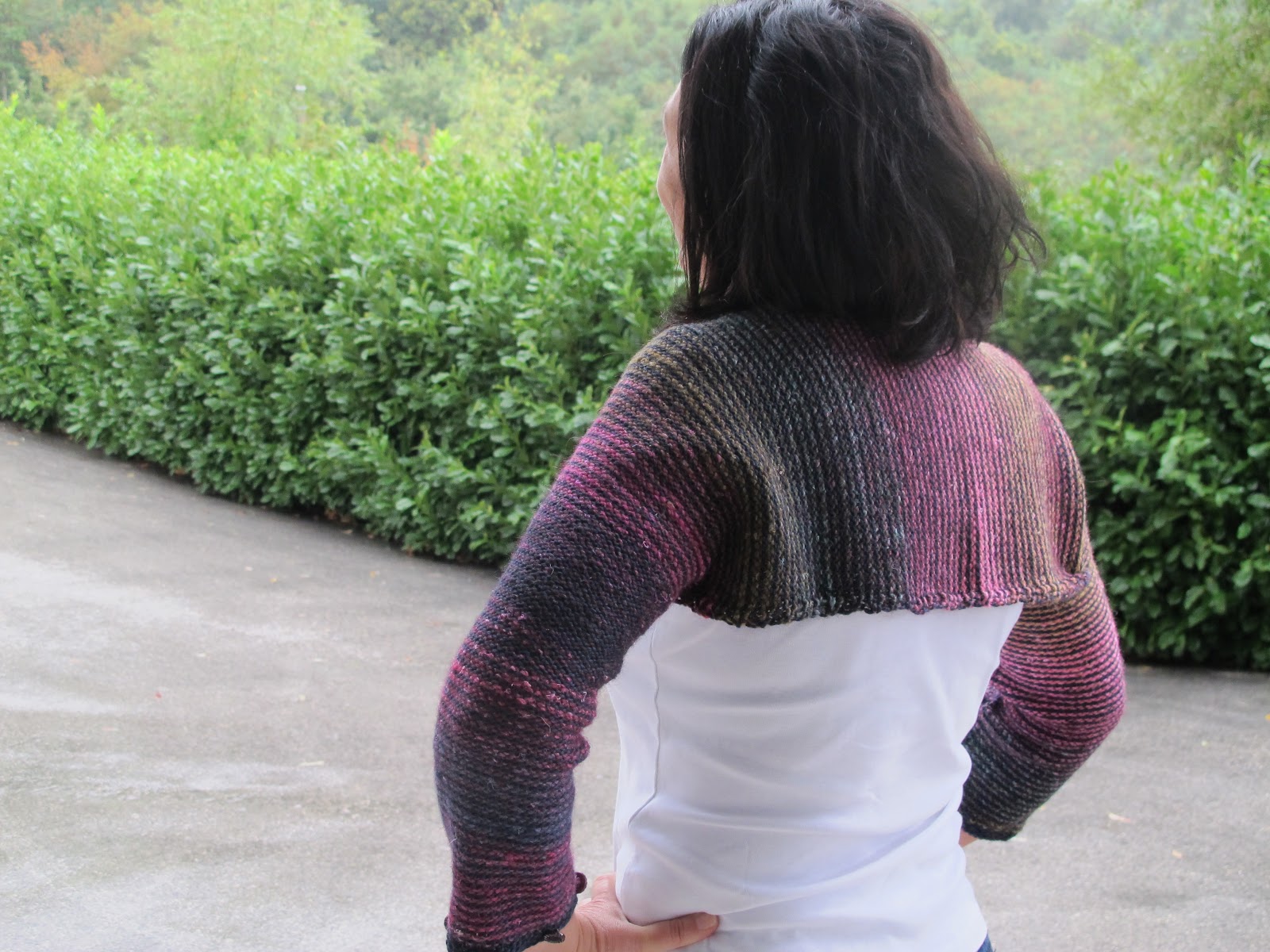
Kudari (che in giapponese significa “righe”) è un mix tra due gomitoli di Silk Garden (45% seta, 45% kid mohair, 10% lana d’agnello, 50 gr = 100 m, colore 282) e altri due di Mirasol Tupa (50% lana merino, 50% seta, 50 gr = 125 m, colore 5), un filato dalla stessa composizione in un bellissimo blu notte che si accosta perfettamente a tutte le sfumature della Noro. 

Per il modello ho preso ispirazione da altri lavori fatti e dalle tecniche che mi sono rimaste più impresse ultimamente. La “forma” – una sciarpa che si può chiudere a formare un collo oppure un coprispalle – deriva da Hari di Olga Kefelian, mentre le righe – realizzate alternando un colore dopo l’altro a ogni ferro – vengono da Kirigami, il pullover di Kate Gilbert pubblicato su Twist Collective. Utilizzando queste righe “singole” il capo risulta essere perfettamente double face - una faccia a rovescio e una a diritto - e grazie a due serie di bottoni – una sul lato corto e un’altra su quello lungo – il lavoro può essere portato in uno svariato numero di modi. Semplice e multifunzione!


Kudari ("stripes” in Japannese) is a mix between two balls of Silk Garden (45% silk, 45% kid mohair, 10% lamb’s wool, 50 g m = 100, color 282) and other two of Mirasol Tupa (50% merino wool, 50% silk, 50 gr = 125 m, color 5), a yarn with the same composition in a beautiful midnight blue that goes perfectly with all the shades of Noro.

For the pattern I took inspiration from other works I’ve done and from few techniques that impressed me more in the last period. The "shape" - a scarf that can be closed to form a neck or a shrug - comes from Hari by Olga Kefelian, while the stripes - carried out by alternating a color to each other row after row- come from Kirigami, a pullover by Kate Gilbert published on Twist Collective. Using these "single"  stripes the item is fully reversible - one side in purl stitch and the other in knit stitch- and with two sets of buttons - one on the short side and another on the long one it can be worn in a several number of ways. Simple and multifunctional!

lunedì 19 settembre 2011

Fragola - Strawberry


Il rosso, ormai l’avrete capito, è il mio colore preferito e l’ho scelto in questa bellissima sfumatura per realizzare un collo morbido e vaporoso.
Il modello è lo stesso della mini cappa fatta con la Puno della Filitaly-lab, un pattern trovato su Vogue Knitting Holiday 2010: un collo che arriva a coprire le spalle, lavorato in tondo seguendo un delizioso motivo-pizzo a foglie, idea della designer Eline Oftedal.
Il filato è lo Shanghai-g della Fonty (72% kid mohair, 28% seta, 50 gr = 80 m, colore 182), un sofficissimo mohair impreziosito da una buona percentuale di seta, che ho lavorato con ferri da 5 mm.
L’originale non prevede la presenza delle frange, ma mi sembrava che ci stessero bene e quindi eccole qua!


Red, as you should know by now, is my favourite color and I choose this beautiful shade to knit a soft and airy cowl.
The pattern is the same of my mini cape knitted with Puno by Filitaly-lab, a pattern found on Vogue Knitting Holiday 2010: a loose-fitting, over-the shoulder cowl worked in the round in a nice lace leaves pattern, from the designer Eline Oftedal.
Tha yarn is Shanghai-g by Fonty (72% kid mohair, 28% silk, 50 gr = 80 m, color 182), a fluffy mohair embellished with a good percentage of silk that I worked with 5 mm needles.
The original has no fringes, but I thought they would be nice and there they are! 


giovedì 18 agosto 2011

The light traveller


Da diverso tempo questo filato giaceva inutillizzato nel mio bagaglio e quindi era arrivato il momento di dargli un po’ di vita !
Alpaca Silk della Blue Sky Alpacas e’ un mix al 50% di alpaca e seta che accosta la morbidezza e il tepore della prima alla lucidezza e brillantezza della seconda, a creare un meraviglioso filato DK (50 gr = 134 m) molto versatile. L’alpaca e ‘ un filato «peloso » e quindi molte persone non lo tollerano (nonostante sia ipoallergenica, sono in tanti che gli allergici all’alpaca), ma unito alla seta questa sua caratteristica si attenua parecchio e il risultato e’ davvero sorprendente : quasi nessun pelucchio lasciato a giro su maglie e pantaloni!
Insomma due materie prime pregiate messe insieme a formare un filato lussuoso ed elegante perfetto per realizzare accessori, come questo poncho da indossare nelle sere d’estate sopra vestiti leggeri o durante il giorno in caso di cambiamenti di tempo improvvisi. Infatti e’ grazie alla luminosita’ e leggerezza dell’Alpaca Silk, a qualche perlina e all’etereo motivo a buchini che sono riuscita a sferruzzare questa soffice nuvola violetta (colore Wisteria).
Parigi sullo sfondo ha poi fatto il resto.


This yarn was sitting in my luggage since ages ago and it was time to let it breath.
Alpaca Silk by Blue Sky Alpacas is a 50% mix of alpaca and silk that match the softness and the warmth of the first  with the gloss and brillance of the second one, creating a wonderful DK yarn (50 gr = 134 m) very versatile. Alpaca is a hairy yarn and because of that a lot of people can not stand it (even if it is hypoallergenic), but with silk this hairs characteristic is attenuated and the result is incredible: almost no hair left on jerseys and pants!
In short, two valuable materials put together to form a yarn perfect for creating elegant and luxurious accessories, like this poncho to wear in the summer evenings over light clothes or during the day in case of a sudden change in weather. In fact it is thank to the brightness and lightness of Alpaca Silk, some beads and the ethereal lacy pattern that I was able to knit this soft violet cloud (color Wisteria).
Paris on the background did the rest!

sabato 23 luglio 2011

Kirigami


Ancora una volta non ho saputo resistere alla Noro-tentazione e ho finito per comprare 4 gomitoli di Silk Garden (45% seta, 45% kid mohair, 10% Lana di agnello, 50 gr = 100 mt, colore 292, 4 gomitoli). Amo le sfumature di questo filato, ma non mi soddisfa il risultato che ottengo lavorandolo da solo e preferisco alternarlo a un altro filo in tinta unita, in modo da far risaltare ancora di più i suoi colori. Questa volta ho deciso di accompagnare la giapponese Noro con il neozelandese Naturally  Harmony Aran (100% merino, 50 gr = 106 mt, colore 801, 3 gomitoli) in una tenue tonalità di beige e la coppia è risultata vincente.

Kirigami è stato un’ottima scelta: un pattern con una costruzione davvero “intelligente” che ha saputo insegnarmi qualcosa di nuovo e interessante da fare con le righe. Prima di tutto le righe, infatti, realizzate con i circolari e facendo scorrere le maglie indietro in modo da lavorare subito un altro ferro con l’altro colore per creare un effetto ottico davvero notevole sul rovescio. Poi la divertente costruzione del collo e delle spalle, un’idea molto semplice, ma allo stesso tempo geniale e diversa dagli altri sistemi per fare le spalle che conosco.

Insomma, per la prima volta mi sono ciecamente fidata delle istruzioni e Kate Gilbert (designer e direttrice di Twist Collective) non mi ha deluso affatto!
Modifiche: le mie maniche sono più corte perché, ahimè, non avevo più filo a disposizione e ho fatto i bordi arrotolati anche in fondo al busto e alle maniche.


Once again I could not resist the Noro-temptation  and I ended up buying 4 balls of Silk Garden (45% silk, 45% kid mohair, 10% lamb wool, 50 gr = 100 m, color 292). I love the shades of this yarn, but when I work it alone, the result does not satisfy me and I prefer to alternate it to another plain color yarn to bring out its colors even more. This time I decided to accompany the Japanese Noro with the New Zealander Naturally Harmony Aran (100% merino wool, 50 gr = 106 m, color 801, 3 balls) in a pale shade of beige and the couple has been successful.

Kirigami was a good choice: a pattern with a really "smart" construction, which has been able to teach me something new and interesting about lines. First of all the lines, in fact, made ​​with circular needles, sliding the work back knitting a new row  with another color to create a truly remarkable optical effect on the back side. Then the funny “afterthought” construction of the collar and shoulders, a very simple idea, but at the same time brilliant and different from other systems to knit the shoulders that I know.

For the first time I blindly trusted the instructions and Kate Gilbert (designer and director of Twist Collective) did not disappoint me at all!
Modifications: my sleeves are shorter because I finished the yarn and I did rolled edges on the bottom of the body and on the sleeves.