Visualizzazione post con etichetta coprispalle. Mostra tutti i post

domenica 13 maggio 2012

Wispy

E' già qualche settimana che il mio Wispy è finito, ma ho aspettato un'occasione speciale per indossarlo e fare qualche scatto. In realtà questo coprispalle era nato per essere indossato sopra il vestito del matrimonio di mia sorella, ma poi il colore del Featherweight è risultato essere migliore e quindi ha vinto lui. Poco male, i bellissimi colori arancio e corallo del mio Wispy (il filato che ho usato è Ella Rae Merino Lace) stanno benissimo sul nero . . . et voilà!


It has already been a few weeks that my Wispy is finished, but I waited a special occasion to wear it and take some photos. In reality this shrug was born to be worn with the dress I choose for my sister's wedding, but as the color of the Featherweight was more appropriate, it won the competition. Not bad, the wonderful coral and orange colors of my Wipsy (the yarn I used is Ella Rae Merino Lace) mix very well with black . . . et voilà!


Qui sono in Brasile, a casa di mio cognato, in occasione del mio compleanno e della mia ultima notte Paulista. Grazie famiglia Villela! =)

Here I am in Brazil, at my brother-in-law's place, for my birthday and last Paulista night. Thank you Villela Family for the wonderful time we spent together! =)


martedì 3 aprile 2012

Pavone Viola | Purple Peafowl


Ecco cosa ho combinato in queste settimane. Non molto direi, ma almeno mi sono cimentata in qualcosa di nuovo.

This is what I’ve done in the last two weeks. Not a lot, I know, but at least I experimented on something new.


Con i due gomitoli di Loden e uno e poco più di Silk Garden avanzati dal Rotation, ho improvvisato questo bolero, sperimentando il Contiguos Method ed utilizzando uno dei miei punti preferiti, il pavone. Così ho montato le maglie necessarie per il collo, aumentato fino al sottomanica e poi ho alternato i due filati per il resto del lavoro, finchè non sono finiti. Per il bordo ho optato per l’i-cord. Ho infine dimenticato di fare l'asola per il bottone e quindi ho pensato di usare il fermascialle della Knit Pro per chiudere il bolero. Oooooopsss!

With two balls of Loden and one and a little more of Silk Garden, leftovers from Rotation, I improvised this bolero, using the Contiguos Method and one of my favorites stitches, feather and fun. So I casted on the right number of stitches for the neck and I increased until the underarms. I then alternated the two yarns until I finished them. For the edges I’ve chosen the i-cord bind off. I eventually forgot to do the buttonhole so I thought usign my Knit Pro pinshawl. Oooopsss!


E ora non mi resta che cercare un bel vestitino, magari viola, da abbinarci!  =)

And now the only thing I’ve to do is to find a lovely dress to go with it! =)


mercoledì 21 settembre 2011

Kudari


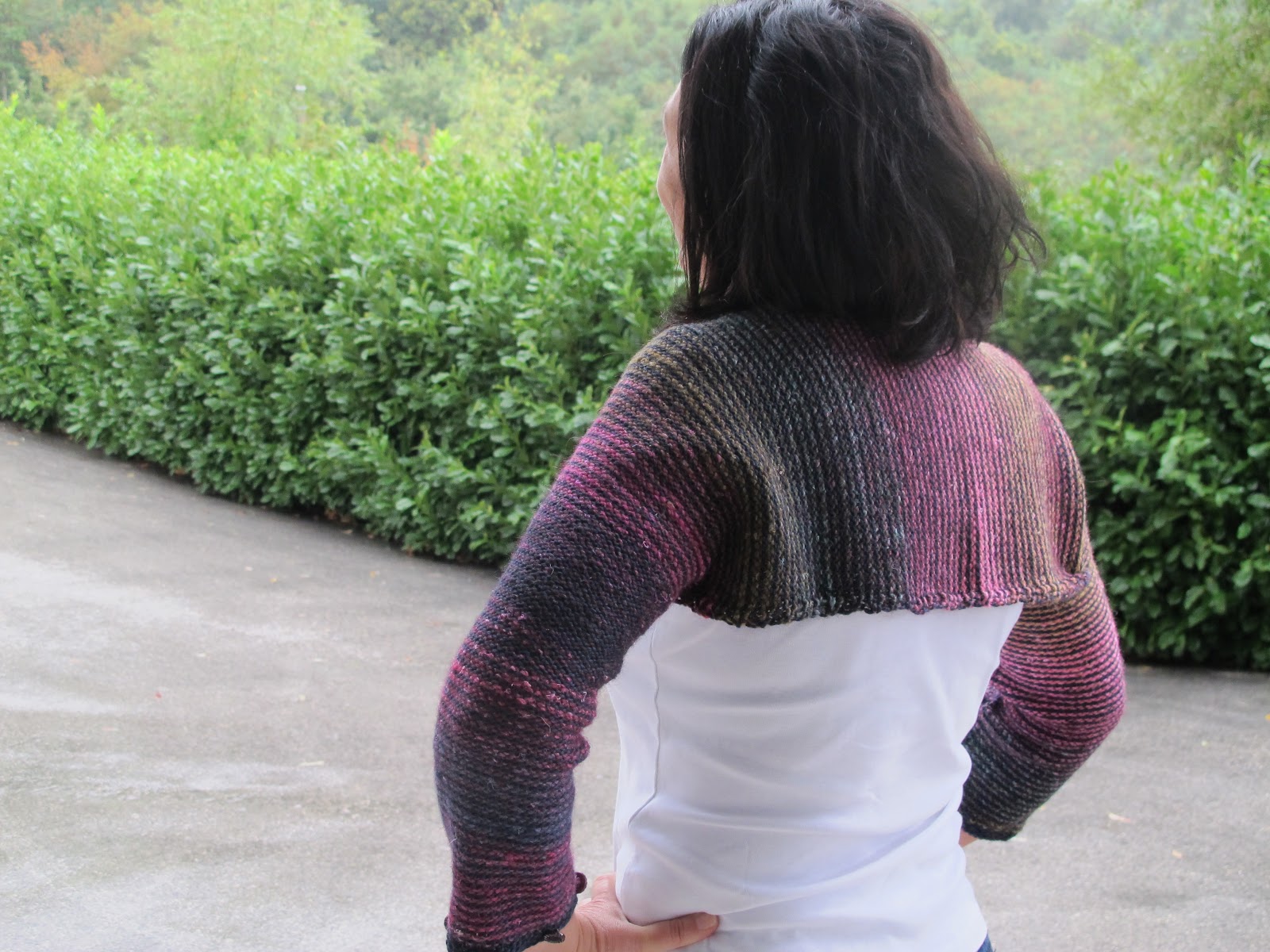
Kudari (che in giapponese significa “righe”) è un mix tra due gomitoli di Silk Garden (45% seta, 45% kid mohair, 10% lana d’agnello, 50 gr = 100 m, colore 282) e altri due di Mirasol Tupa (50% lana merino, 50% seta, 50 gr = 125 m, colore 5), un filato dalla stessa composizione in un bellissimo blu notte che si accosta perfettamente a tutte le sfumature della Noro. 

Per il modello ho preso ispirazione da altri lavori fatti e dalle tecniche che mi sono rimaste più impresse ultimamente. La “forma” – una sciarpa che si può chiudere a formare un collo oppure un coprispalle – deriva da Hari di Olga Kefelian, mentre le righe – realizzate alternando un colore dopo l’altro a ogni ferro – vengono da Kirigami, il pullover di Kate Gilbert pubblicato su Twist Collective. Utilizzando queste righe “singole” il capo risulta essere perfettamente double face - una faccia a rovescio e una a diritto - e grazie a due serie di bottoni – una sul lato corto e un’altra su quello lungo – il lavoro può essere portato in uno svariato numero di modi. Semplice e multifunzione!


Kudari ("stripes” in Japannese) is a mix between two balls of Silk Garden (45% silk, 45% kid mohair, 10% lamb’s wool, 50 g m = 100, color 282) and other two of Mirasol Tupa (50% merino wool, 50% silk, 50 gr = 125 m, color 5), a yarn with the same composition in a beautiful midnight blue that goes perfectly with all the shades of Noro.

For the pattern I took inspiration from other works I’ve done and from few techniques that impressed me more in the last period. The "shape" - a scarf that can be closed to form a neck or a shrug - comes from Hari by Olga Kefelian, while the stripes - carried out by alternating a color to each other row after row- come from Kirigami, a pullover by Kate Gilbert published on Twist Collective. Using these "single"  stripes the item is fully reversible - one side in purl stitch and the other in knit stitch- and with two sets of buttons - one on the short side and another on the long one it can be worn in a several number of ways. Simple and multifunctional!

lunedì 19 settembre 2011

Fragola - Strawberry


Il rosso, ormai l’avrete capito, è il mio colore preferito e l’ho scelto in questa bellissima sfumatura per realizzare un collo morbido e vaporoso.
Il modello è lo stesso della mini cappa fatta con la Puno della Filitaly-lab, un pattern trovato su Vogue Knitting Holiday 2010: un collo che arriva a coprire le spalle, lavorato in tondo seguendo un delizioso motivo-pizzo a foglie, idea della designer Eline Oftedal.
Il filato è lo Shanghai-g della Fonty (72% kid mohair, 28% seta, 50 gr = 80 m, colore 182), un sofficissimo mohair impreziosito da una buona percentuale di seta, che ho lavorato con ferri da 5 mm.
L’originale non prevede la presenza delle frange, ma mi sembrava che ci stessero bene e quindi eccole qua!


Red, as you should know by now, is my favourite color and I choose this beautiful shade to knit a soft and airy cowl.
The pattern is the same of my mini cape knitted with Puno by Filitaly-lab, a pattern found on Vogue Knitting Holiday 2010: a loose-fitting, over-the shoulder cowl worked in the round in a nice lace leaves pattern, from the designer Eline Oftedal.
Tha yarn is Shanghai-g by Fonty (72% kid mohair, 28% silk, 50 gr = 80 m, color 182), a fluffy mohair embellished with a good percentage of silk that I worked with 5 mm needles.
The original has no fringes, but I thought they would be nice and there they are! 


giovedì 6 gennaio 2011

Hari


Non so se iniziare questo post parlandovi della geniale Olga o del favoloso filato ‘Starry’ della Dream in Color.

Appena ho visto il pattern Hari me ne sono follemente innamorata: versatile (puo’ infatti trasformarsi in sciarpa, in collo, in coprispalle o in stola), non troppo elaborato (e quindi facile da sferruzzare) e con un effetto tridimensionale davvero stupefacente (e’ la prima volta che dai miei ferri esce qualcosa del genere!).


Le creste formate dall’alternarsi di maglie accavvallate a destra e a sinistra e dai gettati si susseguono e movimentano il semplice motivo lace che si ripete per tutta la lunghezza del lavoro. L’idea di Olga di cucire dei piccoli ganci alle estremita’ in modo da chiudere la sciarpa a formare un collo o un coprispalle e’ poi davvero originale e permette di personalizzare e variare il proprio stile in un batter d’occhio.


E ora il filato. Starry (98% Merino Australiana e 2% filamenti metallici, 113 gr = 411 mt) si e’ rivelato perfetto per questo lavoro: un colore elegante, il Cocoa Kiss, impreziosito da tanti filini argentati. Un filato che esalta al 100% la dinamicita’ del pattern grazie alla sua ‘alta definizione’. Ho usato un intera matassa e ho continuato a sferruzzare finche’ questa meraviglia non e’ finita. 

Accoppiata vincente.


I don’t know where to start this post, if talking about the ingenious Olga or of the fabulous yarn  'Starry' by Dream in Color.
 
As soon as I saw the pattern Hari I fell madly in love with it: versatile (in fact it can become a scarf, a cowl, a shawl or a stole), not too elaborate (and easy to knit) and knitted with an outstanding three-dimensional effect (this is the first time that something like that comes out from my needles!).

  
The ridges formed by the alternation of the slipped stitches on the left and on the right and of the  yarns over enliven the simple lace pattern that is repeated along the length of the work. Olga's idea to sew the small hooks and eyes on the edges in order to end the scarf to form a cowl or a shrug is original and then really lets you customize and alter your style in the blink of an eye.


And now the yarn. Starry (98% Australian Merino and 2% metallic filaments, 113 g = 411 meters) is perfect for this job: a stylish color, the Cocoa Kiss, enriched by many silver filaments. A yarn which enhances the pattern dynamic due to its high definition. I used a whole skein and I continued to knit until it is finished.

Winning combination.